Malaga airport
Terminals T1, T2, T3
Málaga–Costa del Sol Airport has three terminals — T1, T2 and T3. They are fully connected and operate as a single terminal, making passenger movement easier. The airport also has a General Aviation Terminal for private and sports flights, and a Cargo Terminal.
Terminal T3
If you are flying to or from Malaga Airport — whether it is your first time here or your first visit in a while — it helps to know how the terminal is organized. All signs are displayed in Spanish, English, and German. Here's a complete guide for you.
All commercial arrivals and departures are handled in Terminal T3, the main hub of the airport. The building is divided into four levels: Level –1 (Basement), Level 0 (Ground floor), Level 1 (First floor) and Level 2 (Second floor).
Arrivals –Level 0 (Ground Floor)
Passengers always disembark at Terminal T3 — regardless of whether the flight landed at T2 or T3. After landing, you'll proceed to the Arrivals area at Level 0 of T3. Depending on the flight's origin, you may need to pass through passport control before retrieving your luggage.
How do I know if I need to go through passport control?
-
If your flight originated within the Schengen Area (like Spain or most of the EU), no passport control is required. You'll just follow the signs for baggage claim.
- If your flight is from a country outside the Schengen Area, you'll need to go through passport and immigration control first.
After that, you'll find the baggage claim area, which has 11 standard carousels and one for special baggage. If you have any issues with you luggage, look for the luggage counters for the handling companies, which are also in that area.
After collecting your luggage, you will go through Customs. Here, you'll choose one of two channels:
- Red channel: Use this if you have items to declare, like duty-free goods or cash.
- Green channel: If you have nothing to declare.
Once you're through customs, you'll enter the Arrivals Hall. This is where you'll find everything you need, like car rental offices, tourist information desks, ATMs, and other services.
Right outside the Arrivals Hall is the Transportation Hub. From here, you can easily get to buses, taxis, trains, and the nearby car parks (P1 and P2).
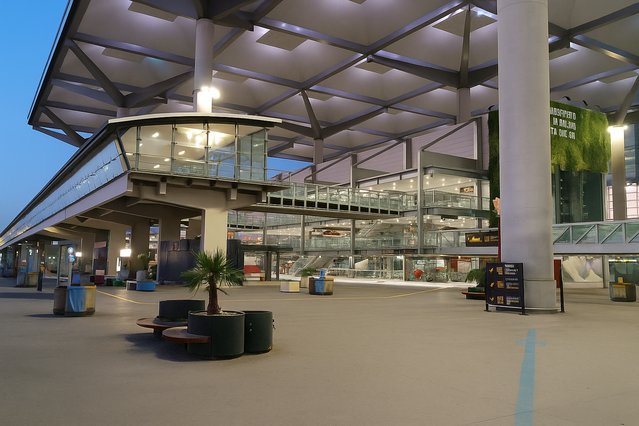
- Commuter train (RENFE) – The Cercanías line C1 takes you straight to Málaga city centre (with connection at Málaga María Zambrano train station with train lines C1 and C2, and the bus station). Also runs to Torremolinos, Benalmádena and Fuengirola.
- Urban and intercity buses –Check your booking for the exact pick-up point — in most cases it’s in the car parks just in front of the station.
- Official taxis. Always available right outside the terminal.
- If you choose a private transfer or other ride-hailing service (such as Uber, Cabify or Bolt), check the pickup point provided in your booking; it is usually the car parks in front of the station.
Departures – Level 1
Information points for passengers and tourists are available throughout the terminal. On Level 1 you’ll also find airline and tour operator counters, where you can get help with tickets, last-minute changes, or other travel needs.
You can shop at the Duty-Free stores, and if you order online at least 24 hours in advance, you can collect your purchase directly at the terminal.
Check-in
Check the flight information screens to find your desk. Even if your check-in or boarding gate is in T2, you can simply walk there without leaving the building — no shuttle needed. In T3, check-in desks are numbered from 301 to 386.
Once you’ve checked in, head straight to security — it’s on the same floor.
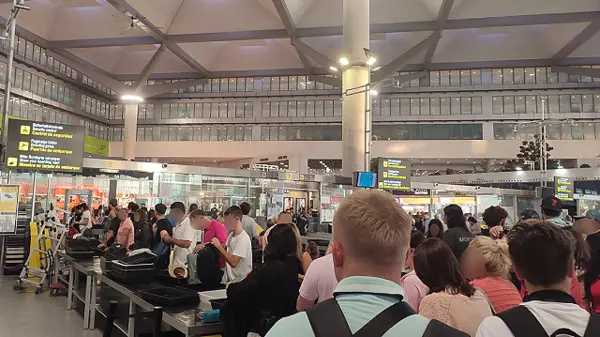
TIP: In a hurry? Use the Fast Lane by the main security checkpoint will save you time, but you’ll need to book ahead.
Boarding gates are divided by type of flight:
→ Pier B (T2): Non-EU, non-Schengen flights.
→ Pier C (T3): EU non-Schengen flights, such as Ireland and Cyprus. Gates C31–C40.
→ Pier D (T3): Schengen flights, gates D42–D68. Services include ATMs, currency exchange, VAT refunds, and self check-in machines from several airlines.
Passenger Services and Facilities
Here are some of the services you’ll find in the airport terminal. For the full list, take a look at the Additional Services section.
Accessibility: Adapted restrooms, PMR assistance points, and free help available on all levels.
Families and relaxation: aby changing rooms, children’s areas, meeting rooms, plus a Silent Room and a Fitness Room within Pier C (after security).
Wi-Fi: Free across the terminal.
Shops & dining: Wide choice of shops and restaurants in public and boarding areas, plus the VIP Lounge on Level 2.
Health & safety: Medical center, pharmacy, defibrillators, and police services: Civil Guard for firearms transport, customs checks, and airport security; National Police for passports/immigration.
Baggage services: Wrapping, scales, and lost & found by the handling offices.
Terminal T2
Terminal T2, designed by Ricardo Bofill and opened in 1991, is directly connected to T3 and just a short walk away. While most operations now take place in T3, T2 is still in use for some departures and boarding, mainly at Pier B.
Check-in counters
Most check-in desks are in T3, but a few in T2 may open at certain times if needed.
Boarding area (Pier B)
Pier B handles flights to countries outside the Schengen Area and the European Union. Although this pier is part of T2, you can only access it through the T3 security checkpoint.
All boarding gates — including Piers B, C and D — are reached from the security area in T3 (Level P1).
Important: T2 does not have an operational Arrivals Hall. All flights landing in Málaga direct passengers through the Arrivals area in Terminal T3 (Level P0).
Are there shops or restaurants in T2?
T2 has only a very limited selection of shops and places to eat. Most cafés, stores, and passenger services are located in Terminal T3.
Terminal T1
Terminal T1 is no longer used for regular passenger operations. It still forms part of the airport complex, but there are no active commercial services, check-in desks, or boarding gates open to the public.
General Aviation Terminal (TAG)
Málaga Airport’s TAG is a small, independent terminal for private, sports, and air taxi flights. It has two levels (0 and 1) and is located in the southern part of the airport, separate from the main terminals.
Customs & Travel Info
Customs
If you’re arriving from outside the EU, you’ll only need to go through Customs if you’re carrying more than the limits shown below. For full details, check the official regulations.
You must go through the red channel if:
- You exceed the duty-free allowance:
- Tobacco (choose one):
- 200 cigarettes
- 100 cigarillos (max. 3 g each)
- 50 cigars
- 250 g of rolling tobacco
- Alcoholic beverages:
- 1 liter of alcohol over 22% ABV, or
- 2 liters of beverages under 22% ABV
- In addition: up to 4 liters of wine and 16 liters of beer
- Value of goods:
- Up to €430 per person (over 15 years old)
- Up to €150 per person (under 15 years old)
- Tobacco (choose one):
- You are carrying cash:
- Amounts of €10,000 or more (or equivalent in other currencies, cash or bearer instruments) must be declared.
- You are bringing controlled products, such as:
- Animal-origin products (meat, milk, etc.)
- Certain flowers, fruit, vegetables, plants, etc. (subject to health and phytosanitary regulations)
- Medicines not for personal use or in large quantities.
Personal medication is allowed, but excessive amounts or without medical justification may need to be declared. - You are transporting weapons, dangerous objects, or licensed products, such as sporting firearms, self-defense sprays, or restricted electronic devices.
Use the green channel if:
- You do not exceed the above limits.
- You are not carrying cash above the permitted maximum.
- You are not transporting restricted or licensed products.
Note: These limits are for guidance only. Always confirm with the Spanish Tax Agency’s website.
Want to know if your destination is in the Schengen Area? Here’s the full list of countries:
Flights are classified according to their origin or destination into three groups:
Schengen countries: Flights to or from countries that have signed the Schengen Agreement. Citizens can travel freely across internal borders. Domestic flights are considered Schengen flights.
The Schengen Area includes: Germany, Austria, Belgium, Bulgaria, Croatia, Denmark, Slovenia, Spain, Estonia, Finland, France, Greece, Hungary, Iceland, Italy, Latvia, Liechtenstein, Lithuania, Luxembourg, Malta, Norway, the Netherlands, Poland, Portugal, Czech Republic, Slovakia, Romania, Sweden and Switzerland.
EU Non-Schengen countries: Flights to or from EU countries that are not part of the Schengen Agreement. Free movement does not apply here. These countries are Ireland and Cyprus.
Third countries: Flights to or from non-EU countries outside the Schengen Agreement.
Further information
More information on the services and options available for passengers.

